Maybe it’s the quarterback chaos or the landslide of head coaching changes. Or because it’s late February and many of the NFL’s personnel departments already seem satisfied that the No. 1 overall pick in the draft is in the barn. Or maybe it’s because the 2025 season produced a wildly unexpected Super Bowl between the Seattle Seahawks and New England Patriots, and an even more unexpected Super Bowl quarterback winner in Sam Darnold.
Whatever the driving force, it’s thrusting the usual sideshow of the NFL scouting combine — trade rumors, free-agency buzz and clandestine general manager meetings — into the middle of the main stage. And with that, the college players who are taking their next big step toward draft positioning have become a subplot.
“It’s going to be a wild offseason and it’s going to start next week [at the combine],” one prominent NFL agent said this week. “There’s so much more than usual with different veteran stuff compared to how guys are going to work out — and we have a good class of guys [in the draft]. All the quarterback things to figure out, some of the [veteran] defensive players — some of the young players that could be traded with the staff changes — there’s going to be a lot going on. …
“I see you guys talking about storylines — when was the last time anyone checked in on what’s going on with Lamar Jackson [and the Baltimore Ravens]? It’s like that situation has gotten lost in all this noise. That’s how crazy next week is going to be, though.”
In fairness, Jackson’s potential extension deadline — spoken into existence by Ravens owner Steve Bisciotti in January — has been a prominent story over the past month. Indeed, it will crank up next week, with the quarterback and franchise having been in a contract talks window for several weeks by the time Ravens new head coach Jesse Minter and general manager Eric DeCosta meet with the media in Indianapolis. It’s expected there will be some kind of temperature gauge coming out of the combine, with the front office and ownership wanting to sign an extension with Jackson and lower his $74.5 million salary cap hit in 2026.
Of course, Jackson is only one of multiple pressing maneuvers — or non-maneuvers — heading into the combine that will certainly drain some of the daily news thunder from draft prospects’ workouts. Among the prominent:
Who will be getting the franchise tag applied to them before free agency, with the biggest name being Dallas Cowboys wide receiver George Pickens. As it stands, Dallas is expected to tag Pickens prior to the March 3 deadline and then either attempt to retain him or try to engage in a sign-and-trade scenario. With Pickens wanting to get to free agency and a likely $35 million average salary per season, there will likely be sparks in a tag scenario.
Potential veteran trades, including Las Vegas Raiders defensive end Maxx Crosby, Philadelphia Eagles wideout A.J. Brown, Miami Dolphins quarterback Tua Tagovailoa, Arizona Cardinals quarterback Kyler Murray and others. Throw in some young players who might get a call or two just to see if they are available on the trade market, including Buffalo Bills wideout Keon Coleman, Jacksonville Jaguars wideout Brian Thomas Jr., Indianapolis Colts quarterback Anthony Richardson and Minnesota Vikings quarterback J.J. McCarthy.
The future of Aaron Rodgers will be a pressing question for the Pittsburgh Steelers — at least as it pertains to the organization’s other options and what kind of timeline there would be for a Rodgers decision. It’s possible we exit the combine under the presumption that the Steelers are going to move forward and try to find their future QB, which would shift the Rodgers conversation back to the Vikings, whom he was interested in before landing in Pittsburgh last offseason.
And finally, one very big nugget that has yet to be developed: How much interest there will be in Malik Willis in free agency and what the money could ultimately look like. The ballpark speculation in the agent community is some kind of two-year deal averaging $30 to $35 million a season with $40 to $45 million guaranteed. That would put Willis in position to go back to the table next offseason and negotiate a longer term deal that tacks on to the end of 2027 and extends his guaranteed money out into a three-year window through the 2028 season. There are varying opinions on the numbers and structure, not to mention the potential interest. Willis feels like the first big quarterback domino that has to fall in March to trigger a larger migration. If he were to land in Pittsburgh, that then puts Rodgers — if he still wants to play — onto the market for the Vikings or any other suitors. And once Willis is off the board, the teams that ultimately don’t have him as an option will then have to reassess.
There’s a sliding scale of a trade likelihood for all these players. Crosby’s situation with the Raiders, from what Yahoo Sports has been told by league sources familiar with their talks, is still at a standstill — but also not unrepairable. Part of the Raiders’ motivation is to see what Crosby’s trade market looks like and also where he is at with the franchise in a new phase of a rebuild. The market will likely be the driving force here. If there is a solid offer of draft picks on the table, a trade seems more likely than not.
The same goes for Brown and the Eagles, although it remains to be seen what general manager Howie Roseman could engineer to fill his No. 1 wide receiver spot if there is ultimately an attractive offer available for Brown. It’s highly unlikely the Eagles would move Brown and not have another player in the mix, so the combine’s wide receiver workouts and other available players at the position could factor.
The Murray and Tagovailoa process is going to depend on suitors and money. Right now there are zero indications of an appetite to take on either Tagovailoa or Murray’s remaining contract in a trade, let alone surrender any meaningful draft assets to make him a starter. That could change if the QB shuffling doesn’t break right for some teams and desperation enters the scenario. Lest anyone forget, there was a market (albeit diminishing) for Russell Wilson the past two offseasons. So there can certainly be a market for Tagovailoa or Murray if a situation gets bad enough.
As for the young players, Coleman seems likeliest to be traded, given the comments of Bills owner Terry Pegula that essentially branded him with not being the front office’s draft choice. Unfortunately for Buffalo, Coleman’s trade value will be nothing more than a late pick at this stage. Even with his youth.
Thomas, Richardson and McCarthy are not expected to be officially on the trade block, but all three could garner some interest and calls. Thomas seems less likely to be dealt with the Jaguars moving Travis Hunter primarily to cornerback. McCarthy won’t be dealt unless the Vikings are presented with a quarterback option that effectively renders any chance of him having a future as moot. And Richardson doesn’t have much of a market, and will have only one year left on his rookie deal once his fifth-year option is ultimately declined. That doesn’t leave much room to develop him for any interested franchise. But again, we don’t know how desperate the quarterback field gets.
That’s a lot of veteran questions and potential developments that will hang over the primary reason teams are in Indianapolis next week: To begin laying down the foundations of their draft boards for April’s selection process in Pittsburgh. While the veteran news and ramp up to free agency will cast a long shadow in Indianapolis, it won’t eliminate a litany of prospect-related storylines that will get rolling once workouts begin.
Here’s a look at some of those that will be worthy of watching.
The top of the wide receiver group
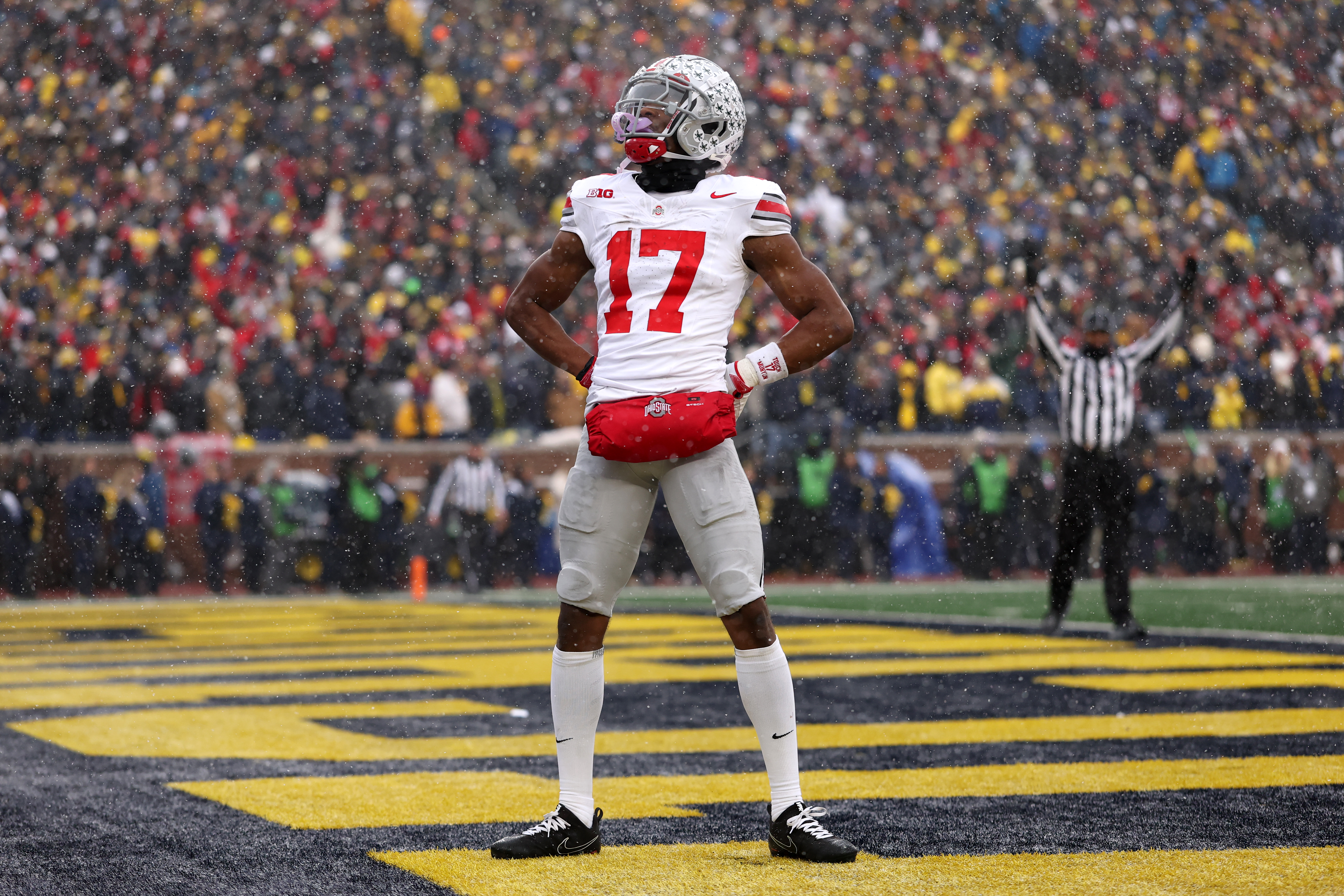
While it’s not expected to be as top heavy as the 2024 wide receiver class — which saw seven first-round picks at the position — the wideouts are considered a spot that is going to have depth and offer needy teams quality options potentially into the third round. The general consensus at this point is that four to five receivers could go in the first round. Most of the intrigue will be how the top of the class sorts itself between the trio of Ohio State’s Carnell Tate, Arizona State’s Jordyn Tyson and USC’s Makai Lemon.
“I think you could see some [changes in that trio] between interviews, measurements and whatever work gets done,” one NFC talent evaluator said. “The medicals, too — definitely the medical for Tyson. … And it depends how you want to use them in your scheme. Lemon, some teams might not like the size but others might love the versatility and how he catches it. How fast will Tyson run and some of the speed and agility things with Tate will be important. They’re all good players, but there’s definitely some of the [Travis] Hunter, [Tetairoa] McMillan, [Emeka] Egbuka [conversations from 2025] because they’re not all similar players.”
As it stands, Tate appears to stand out among talent evaluators as the most “clean” player from the threesome, in terms of the total package of consistency, health, size and production. But there’s definitely curiosity about what his pure speed and agility will look like, especially alongside Lemon and Tyson. Some of those questions will be answered — if all three actually do full workouts at the combine, which isn’t guaranteed. Beyond that trio, there will definitely be some gravity toward the next tier of WRs in Washington’s Denzel Boston, Tennessee’s Chris Brazzell II and Notre Dame’s Malachi Fields, who all bring prototypical “X” receiver size to the table. The Bills will be an interesting team to watch with that group.
Quarterbacks not named Fernando Mendoza
For only the second time in 13 years, we could end up seeing only one quarterback selected in the first round. With the Las Vegas Raiders expected to take Indiana’s Fernando Mendoza with the No. 1 pick, it’s also trending toward Mendoza passing on everything at the combine and opening the floor for the rest of the class. That will be a solid opportunity for multiple players, including Alabama’s Ty Simpson, Penn State’s Drew Allar, Miami’s Carson Beck, LSU’s Garrett Nussmeier and others.
It’s simply not a great class when it comes to star power (that will come in 2027), but there could be a bit of developmental depth with some strong showings.
Even with the thin class, there is still plenty of quarterback need across the league — and that will point plenty of eyes in the direction of Simpson. He was a prospect with some solid draft heat near the midpoint of the college season, but red flags began to get raised as he got knocked around and turned the ball over later in the schedule and then suffered a rib injury that knocked him out of the College Football Playoff. Right now he’s likely to land in the late first to mid-second round range, somewhat similar to how teams were looking at Bo Nix in 2024, and Jaxson Dart and Tyler Shough last year. If Simpson can wow teams in interviews and put up a good workout, he can build momentum to move up the board and get a QB-needy team to expend a first-round pick on him. Already, you hear his name connected a lot to the Los Angeles Rams, who have the 13th and 29th overall picks.
As for the rest of the pack, it’s unclear what Allar will be able to do at the combine due to an ankle injury that ended his season. He’s the player with the size and easy arm strength, so he’ll draw in someone believing they can hone his considerable talent into consistent results. Same goes for Beck, who also has size and arm, but also some leadership and love-for-the-game questions that teams want to pick at in interviews. Not to mention some bad turnovers in important spots, going all the way back to his time at Georgia. Then there’s Nussmeier, who some evaluators once believed could develop into a first-round pick, maybe even a solidly high one, before injuries derailed much of his 2025 college season. He’ll be another player who draws plenty of eyeballs.
Defensive picks almost everywhere
It’s a loaded class with edge players, with an onslaught at that position expected to end up packing the first round. While there’s still a lot of work ahead, it wouldn’t be surprising to see as many as eight edge rushers come off the board in the first 32 picks. A lot of the attention will go to potential top-10 picks in Texas Tech’s David Bailey, Ohio State’s Arvell Reese and Miami’s Rueben Bain Jr. But there will be a battle to figure out the stack after that trio, with players like Auburn’s Keldric Faulk, Missouri’s Zion Young and Miami’s Akheem Mesidor battling it out. Young is a player to keep an eye on. He had a great week of practice at the Senior Bowl and ended up as the game’s defensive MVP, giving him a lot of buzz coming into the combine. But top to bottom it’s going to be great draft for teams that need edge players and just defensive line talent in general.
“It might be one of the deepest [edge] classes ever, especially through the top 50, 60 guys [in the entire draft],” an AFC general manager concluded. “There’s all types of skill sets and body types that fit different needs, but the talent in general just very, very good. There’s really not a Myles Garrett or Nick Bosa, but there’s a half dozen guys who could become just good, core second-contract players for teams.”
Beyond the defensive line, there’s strength in the class of safeties and cornerbacks as well, with as many as a half dozen or more picks in the secondary likely to land in Round 1. And while safety isn’t traditionally a position that sees multiple first-round selections, this will almost certainly be one of those years, with Ohio State’s Caleb Downs, Toledo’s Emmanuel McNeil-Warren and Oregon’s Dillon Thieneman all having the profile to possible land in the first half of the first round. That just doesn’t happen. Downs in particular will be very intriguing. His résumé is the kind that he’d be an easy top-five pick if he played at a more premium defensive position — and there were times that some evaluators believed he could even be worth that kind of juice in this draft. The overall strength of the defensive class at premium positions is likely to push him down the board, but it’s certainly not lost on front offices that so many of the NFL’s best defenses now feature a dynamic safety like Downs. That could cement Downs higher on teams boards by April.
Alvin Kamara comparison builds for Notre Dame’s Jadarian Price
The next running back after Notre Dame’s Jeremiyah Love is going to be an interesting development to watch. Overall the class isn’t amazing and it’s going to be dinged a bit by the free-agent class being so strong. There’s no doubt that some teams want to see what Love’s backup for the Fighting Irish, Jadarian Price, does in the workouts. As much as game tape matters, Price could have transferred elsewhere for the 2025 college football season and doubled his touches while positioning himself to challenge Love as this year’s top running back. Now he comes into the draft with less wear and tear but also some curiosity about whether he can be a centerpiece starter and also catch the ball consistently out of the backfield. His workouts will matter. Especially as it pertains to his receiving ability. If he can showcase that and put up the type of athletic numbers than some think he can, there will likely be more Alvin Kamara comparisons to follow. As of now, I’m not sure how that framing works without the receiving end of his game being more proven.
TE Kenyon Sadiq a talent evaluating mystery
Oregon tight end Kenyon Sadiq is going to be interesting. Some evaluators like him as almost a hybrid running back/wide receiver if he fits into the right scheme. Others see him as a plus level athlete whose “expected” 6-foot-2 240-pound size is going to make him a bit of a tweener — and not in a good way — in the NFL. There’s curiosity about Sadiq’s true height and weight, and what his workouts look like. There’s little doubt he has mismatch potential and maybe some considerable ceiling with the right coach and scheme, but some evaluators don’t see him as the kind of tight end who can fit in a lot of different places and be on the field at the rate of a multitude of TEs from last year’s draft. He can’t be compared realistically to the bigger bodied guys like Colston Loveland and Tyler Warren. And his overall consistency of college production wasn’t in the realm of Brock Bowers going into the 2024 draft. Who is the realistic comparable at the NFL level to Sadiq and what coach can draw that uniuqe talent out of him?